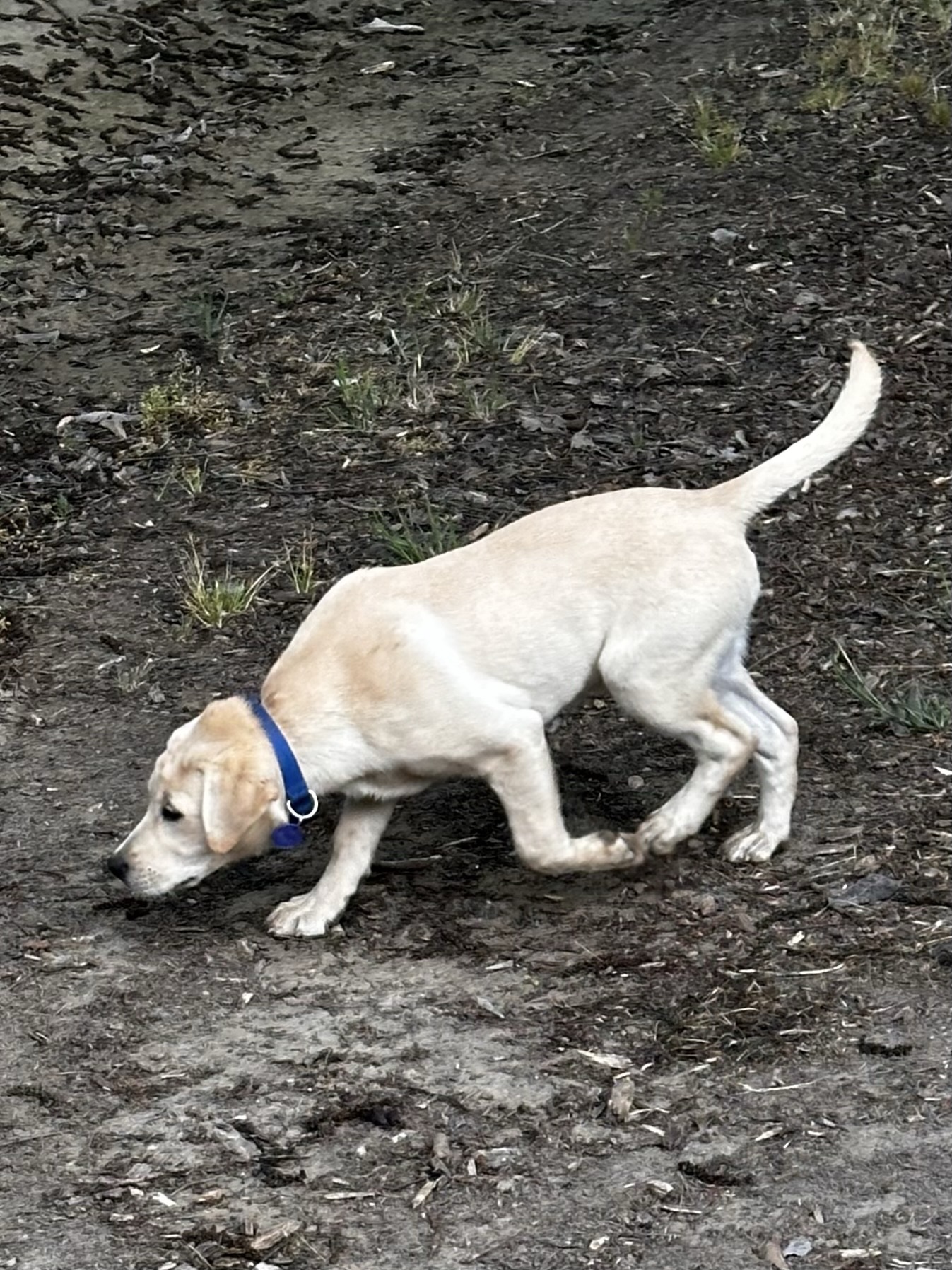
Just about anytime we’re at an event, folks ask, “Can any dog be a truffle dog?” The short answer is yes. But a better question might be, “What makes a great truffle hunter?”
WCTD- A history
A West Coast Truffle Dogs, we’ve had many a dog over the years. We’ve had tall ones and short ones, fat ones and skinny ones. We’ve had hounds and retrievers, super-muts and purebred pups. We’ve had GSD’s and Weimaraners, Dachshunds and Dobermans, Lagottos and- well, you get it. And to be fair, while not all have been part of our truffle team (some were from childhood), we have loved them all.

Love for the Labrador
But despite our affection for all of our furry friends, past and present, no dog has played a larger role in our lives than the lovable Labrador. Megan, Creek, Charlie, Bryn and Bailey, we’ve had them in every size and every color. What started as a search for the perfect family/upland hunting dog in the mid-90’s, turned into a life-long affection for the lovable lab. It’s no wonder that the Labrador Retriever has been the most popular breed in American history, holding the top spot on AKC’s list for 31 consecutive years!
Popularity
But does just being the country’s most popular dog make the Labrador the best truffle dog? Well, yes and no.
Popularity these days often begins with social media and influencers. People see something online and imagine being whatever they see. As a result, popularity is often much less about suitability and much more about imitating something we’ve seen on screen.
Take the Lagotto Romagnolo. They’re the Italian truffle dog after all, and they look like a doodle, a recent trend in America, so… they must be perfect dog for truffling. Well, they might be, but we will discuss that later. The truth is, however, (as a Lagotto family) they’re quite a quirky dog that’s not the best for everyone.
Why the Labrador
Temperament: Believe it or not, temperament is often one of the most important, and most overlooked, of dog ownership considerations.. Rather than considering what it’s like to live with this dog, we tend to think about what it will look like on our Instagram. The Labrador Retriever has been bred over the years to be the constant companion of a hunter. They are equally adept at relentlessly running down pheasants in the open field or sitting quietly and alertly for hours in a duck blind.
Many decades of focused breeding, combined with their natural dispositions, makes Labs one of the easiest breeds to train. Their desire to please their people, a lack of general stubbornness, and their overall amicable nature means that even the amateur owner can be successful in teaching the necessary skills to a Labrador.
At home, Labs will need exercise and play, but are just as comfortable cozying up by the fire. They love people, which is helpful when you’re hunting with other folks, and are rarely dog aggressive. They are the consummate happy helper, motivated by food or affection; they are adept learners and easily trained.
Finally, we’ve also found our Labs to be less distracted than breeds like spaniels and hounds. They seem to understand the job and stay focused (mostly) on the task at hand.
Size: The Labrador is not a small dog. But what many folks don’t realize is that they have a pretty significant size range. Some British field Lab females will barely break 40lbs, fitting into the medium dog category. But if you love a big dog, Labs can easily reach 80+ while maintaining a healthy conformation.

We have certainly seen the benefit of size. Larger dogs cover ground easily, can push through dense cover and manage fowl weather well. Depending on your environment, smaller dogs may struggle in heavy underbrush or in orchards that haven’t been well-maintained.
It’s important to consider what will best fit your lifestyle and hunting needs. All puppies are small, but most don’t stay that way. What is going to work well in your home as well as on the road? Bigger dogs eat more food, need more space, are often more expensive at the vet, and can be prone to more health challenges if not managed well. But unlike other hunting breeds, Labs have an off-switch that, with adequate exercise, will allow them to adapt to just about any living space.
Care: Are you prepared to regularly bathe your pup? What about monthly trips to the groomers? How much time and money do you have in your budget for grooming your new best friend?
Much like their temperament, Labradors are pretty low-maintenance. They don’t need regular baths and they don’t need special grooming. They do shed, and depending on your climate, this may be something you need to manage, or just a minor inconvenience. The best thing we’ve found is a Furminator. It is a great tool for quickly removing your Labrador’s shedding coat.
As with all breeds, there are some considerations. Because they love water, they can get issues with their ears. We use witch hazel wipes and simply wipe our their ears as needed.
Perhaps the most important consideration when it comes to caring for your Labrador is weight management. Free-feeding is just not an option. Scheduled, measured meal times will help insure you avoid the joint problems that can affect most large breeds. Making sure your food is appropriate for large breeds, and hopefully contains reasonable amount of Glucosamine and Chondroitin, will go a long way to giving your pal a long and healthy life.

Skill: This is where a Labrador really shines. In addition to being easy-going and family-friendly, Labradors are bread to hunt. They have one of the best noses of any breed (always ranking in the top 5), will go in the field for days, travel easily and love a challenge. There is a reason that so many professional organizations using Labradors for nose work. The combine people skills and hunting skills in a way that few if any other breed can replicate.
Labradors are like the Swiss Army knife of hunting dogs. They are adept and hunting in nearly every climate and every condition. As a puppy, they will hunt without any training or prompting. The goal of the trainer is to refine and direct these natural instincts, which can be easily done with a little effort.
And you only have to look to the most productive truffle growing countries in the world, Spain (total volume) and Australia (productivity per hectare), to see that the Labrador is chosen time and time again by growers and professional truffle dog handlers. That’s definitely worth noting.
Availability: One of the challenges with some breeds is availability. This is a challenge for two reasons: 1) a sudden growth in interest can drive prices up significantly, and 2) the genetic pool can be very shallow, resulting in dogs prone to health issues.
This is another area where owning a Labrador can have significant benefits. Because they have been so popular for so long, not just as family dogs but as hunting dogs, there are numerous opportunities to find a quality puppy. In addition, their health issues are well known and can be screened for. Breeds with less of a history in this country may have health issues that are not yet well known.
High-quality, health-tested Labradors in the U.S. can be obtained for less than $1000, and some of the very best are available for $2500 or less. This is a far cry from some of the more trendy breeds, which can easily be $4500 or more, and in some cases exceed $10,000.
Wildcards: I wasn’t sure what to title this section, but this is where I want to speak specifically about things we’ve found that make a particular breed a better fit. (Note: We hunt mostly in orchards, so that influences our overall opinions).
One thing we’re noticing more and more is the presence of burrs, foxtails and stickers in many of the orchards we work in. Dogs with flowing locks or curly hair are especially susceptible.
What starts off as a small nuisance, can ultimately halt your dog’s progress, their coats becoming Velcro for burrs (literally how hook and loop fasteners were invented). Overtime, these prickly little pinwheels accumulate in your dogs toes and fur, eventually causing them to stop hunting to try and remove the irritations. While this may seem like a small nuisance, it can be a big deal, and even threaten your dog’s health.
Our Labs have no such issues. Like Teflon, their close coats shed nearly everything it comes into contact with, from water to stickers. In comparison, we’ve literally spent 45 minutes working like human spider monkeys to remove all sorts of stickers, burrs and debris from our other dogs, even when we’ve tried to keep their coats short.
Conclusion
Sometimes the best things are right in front of us. While we are prone to looking for the new shiny toy, the right option might have been in front of us all along.
We think the Labrador might be the perfect truffle hunter because they:
- Have a long history of hunting companion AND family friend
- Are easy going, low maintenance and proficient in the field
- Come in many shapes, sizes and colors
- Are easy to train, even for amateurs
- Love people, other animals
- Enjoy a crowd or a cozy corner
- Are widely available and not prohibitively expensive
Owning a dog is a very personal decision. Ultimately, how well a breed works for you is as much about you as the breed. But we hope this little Labrador exposé might be helpful as you search for your next furry friend.
Have a question or a comment? Reach out and we will be delighted to chat.
Leave a Reply