How we got here
Collars have been an essential part of working with dogs since time immemorial. Undoubtedly, they emerged as a way of controlling the animal. Whether by leash or tie-outto restrict movement, or even pinch-and-prong collars to address behavior. Eventually, the wearing of a collar would provide a means of identification, a place to put a license, and a name tag. Today, these remain the two primary uses, though technology has entered, bringing with it the ability to add location services like GPS or remote control for e-collars. But either way, they continue to primarily ensure that we know where our dog is, and others know who she is. While most folks find the standard collar/tag to be adequate for service, we’ve found the benefit of modern collars.
Hunting
It tends to be the case that where we see more advanced collars is in the working/hunting dog arena. From the advent of “shock collars,” now politely referred to as e-collars, up to more advanced, GPS tracking models. While not the place for the debate, suffice it to say that I believe the trained, experienced use of an e-collar can reap significant rewards and provide a level of control unattainable with other methods. EQUALLY, I believe the untrained and inexperienced use of an e-collar is not only inhumane, but is the quickest way to ruin a dog. When in doubt, don’t use one.
Hunting with dogs can almost always be improved with the use of an advanced collar. With GPS, they can provide not only real-time information on the location of a dog working ahead of you, but can also provide an important record of the days effort. With this information, we can remember what area we’ve covered and what needs to be hunted tomorrow. We can record the days successes, and recall what areas were the “hot” ones from season to season.
And with an e-collar, we can also increase our range of control, helping us get the dog’s attention when something unexpected arises, whether from wildlife or domestic life. Our dogs have excellent recall, but once, when we were hunting a private orchard, a dog walker with three massive dogs entered the premises. Unfortunately, in this instance, our lab didn’t have an e-collar on. He went charging over to see these new friends, and all I could do was yell, “dog, dog, dog.” This trio, in turn, dragged their handler across the orchard until she assumed a seated position and dug her heels in. The only thing that kept this from getting out of control was the simple fact that our dog is not dog-aggressive. Coming face to face with the hounds of hell, he decided it wasn’t the day for sniffing and friendly greetings and retreated to me and my leash. There are times when control at distance is a matter of safety.
Dogtra
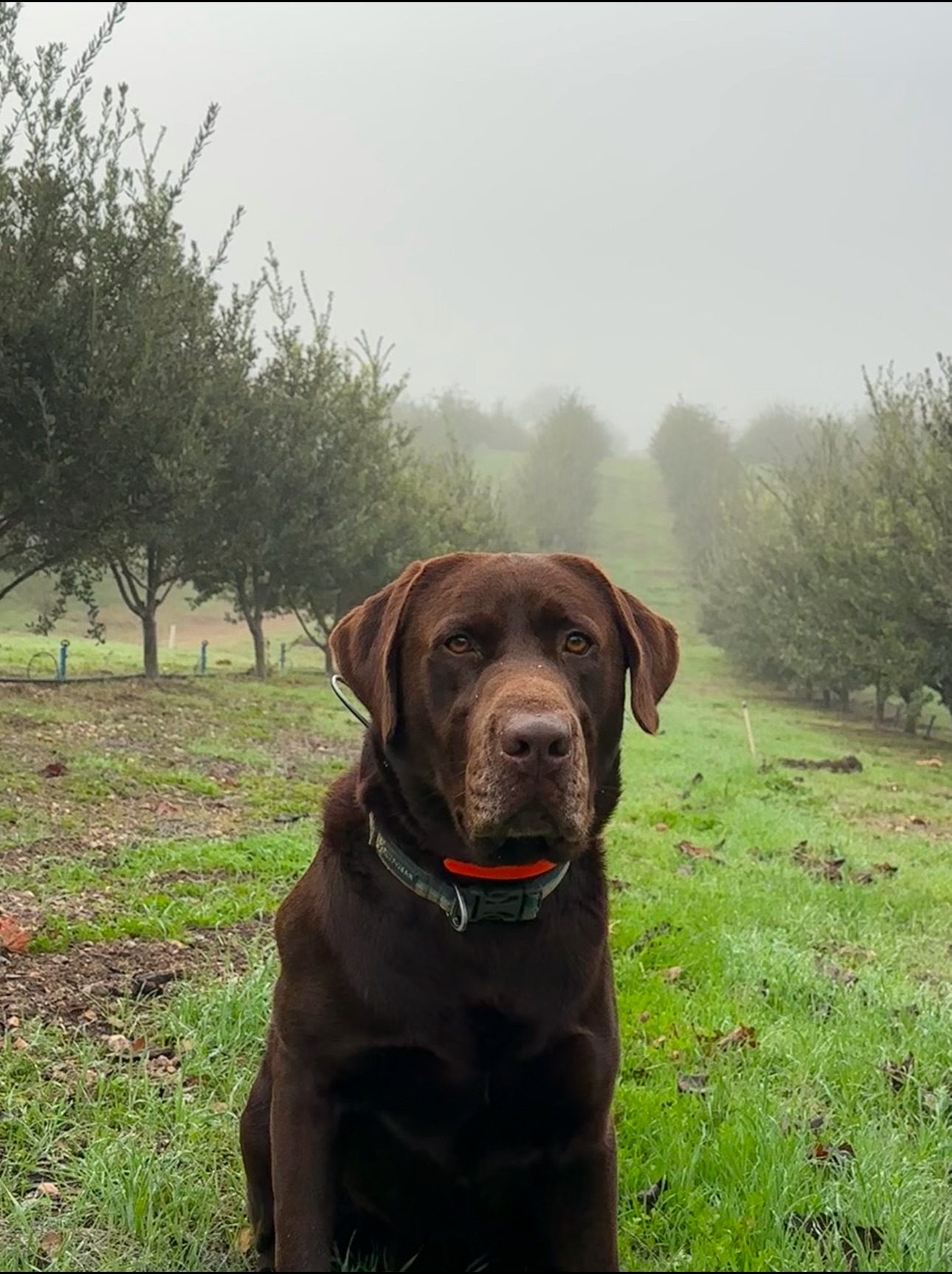
Our collar of choice is the Dogtra Pathfinder 2 mini. In spite of the fact that our primary truffle dog is 85+ pounds, we opted for the smallest effective unit. It is lightweight and capable of tracking up to 4 miles. It allows us to use either a transmitter or our phone to control the dog. You can add multiple dogs to the same control, though we have not done this. It can provide enough stimulus (buzz or shock) to get the dogs attention, as well as a tone. We have found that in nearly every case, a tone is adequate. Everything can be selected from your phone.

Despite hunting in some of the most remote places in CA, well out of cell phone range, the Dogtra has never failed us. Once the collar and transmitter/phone are paired, we can immediately see our dog and ourselves on the screen. You can add a “truck” if you want, which will help any hunter find her way back to the car. In addition, it tracks both the dog and the handler separately, showing the ground covered by each. It also estimates the dog’s movement, and will signal if the dog is running, stopped, or has treed an animal. It’s pretty impressive. All of this, along with stimulus control, can be seen on the phone’s screen. Additionally, you can add finds to the map to track where you’ve taken game, or in our case, found truffles. However, we use another app for that.
Indespensable
When it comes to truffle hunting with our dogs, I can’t think of a more helpful tool. Because we are hunting for owners, the ability to know exactly where we’ve been and what areas the dog has covered is priceless. Without exception, the dog covers 2-3x what the handler does, which helps determine what’s been checked and what hasn’t.
Additionally, when we are surveying new orchards, especially those that haven’t come into full production (read: 95% of all truffle orchards we visit), seeing the dog’s movement on a map helps us identify potential future truffle locations. It is clear as day when a dog is on scent, and even if no truffle is found, it’s essential information. The Dogtra map will record the circling, turning, and repeated searching of specific areas, all of which is so easy to see when you look back at the map. This is very useful for your next visit and suggests potential hotspots for future finds.

And obviously, using a map to mark finds is incredibly helpful. As we’ve visited orchards throughout a season, and season after season, having these records provides a visual that starts to look like a fungus spreading across the orchard… because that’s precisely what is happening.
Finally, the Dogtra collar gives us that extra bit of security to know that if needed (and only if), we can communicate with our dog, with a variety of methods, at nearly any distance necessary. It is almost never needed- but when it is, it’s critical.
Final Thoughts
We are big advocates for modern collars when hunting with dogs. In fact, a good collar may be the most essential tool you purchase. There are several shapes, sizes, and capabilities out there. The reality is, these are not simple, nor are they cheap. If you choose a collar, make sure you find the one that best suits your purpose. And if you decide on an e-collar, make sure you train thoroughly before using it. This is NOT simply reading instructions; it includes finding professionals —online or in person —to help you know when, how, and when not to use stimuli.
Please subscribe for newsletter updates. If you have any questions, we’re here to help. Reach out anytime:
brice@westcoasttruffledogs.com, or
erin@westcoasttruffledogs.com
Cheers!
Leave a Reply